

Home » Move on up?
Move on up?
Hand wrapping is obviously the easy way to get things done if your operation is only wrapping the odd pallet here and there. But what happens when pallets are being sent out with greater frequency?
Here are four things to consider before making the the move from hand wrapping pallets to semi-automated pallet packaging.
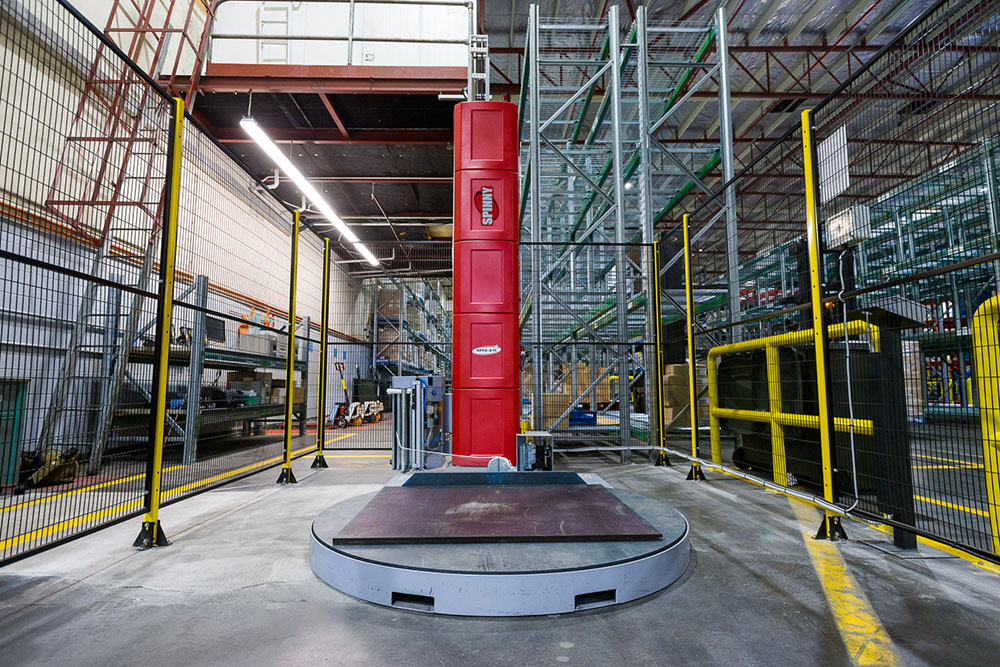
There is no hard and fast rule for when it’s best to make the move to a Spinny pallet wrapper – it can be difficult to establish when the exact tipping point is for ensuring the fastest and most cost-effective move into semi-automation.
So, before organising for a site visit or wrapper demonstration assess the key cost drivers behind stretch wrapping – particularly when it comes to product damage, labour investment, and pallet wrap spending.
1: I Want To Break Free
Product damage is a huge deal when it comes to unnecessary waste and unhelpful costs. In-transit damage from improperly wrapped loads is the biggest cost driver in stretch wrapping.
The statistics paint a clearer picture here. Studies show ineffective wrapping causes approximately $1 in product damage for every $1,000 of goods a company will send. If a company ships $25,000 of products per day that means they’ll lose over $6,250 each year to damaged goods – and over $30,000 in damage over five years.
Covering the costs of a move to semi-automation
2. Mr Roboto
The cold, hard reality is that machines are often cheaper than humans. Putting your people where they can do their best and enhancing their productivity in other areas is common sense.
One way of freeing up time is by using a machine with a built-in scale instead of moving the pallet from a wrapper to a freestanding scale. With this change, if a company wraps 30 loads per day (with employees paid $24 an hour) over $22,000 of wasted labour can be saved over a five-year period. That figure is just with an automated weighing system – there are plenty of other ways to increase efficiency with a Spinny wrapper too.
3: Reach Out, I’ll Be There
Being able to effectively pre-stretch film can dramatically reduce stretch wrap use and associated costs. The powered pre-stretch capability of a Spinny wrapper can cut these costs by 50% when compared to hand wrapping.
These potential savings obviously depend on how many loads your company will wrap each day. If you’re only wrapping a few loads a day it won’t yield much benefit, but if you’re a larger company it’s worth running the figures. Wrapping approximately 30 loads a day will see savings of over $3,000 a year if you switch from no pre-stretch to 200% pre-stretch.
4. Fix you
Maintenance costs are always worth thinking about when buying a pallet wrapper. Most pallet wrappers require minimal maintenance in the first few years. During this time, it would be expected that about 2% of the machine’s cost would be paid in maintenance (i.e. $300 for a $15,000 machine).
However, like most technology, as the machine gets older maintenance can get more expensive. With a sound maintenance plan for a pallet wrapper everything can be cost-effectively covered – and parts replacement and servicing will be carried out extremely quickly.
5: What It’s Worth
As with many things in life, sometimes the cheapest approach to pallet wrapping isn’t the least expensive in the long run. The actual machine cost of a semi-automatic stretch wrapper is incredibly low when compared to the thousands of loads it wraps during its economic life.
If you wrap 50 loads a day over 10 years a $15,000 stretch wrapper only costs 12 cents per load. While adding further automation features increases the additional price tag, the cost per load does not increase much over the 10 years (i.e. an extra $2000 on 50 loads a day equals one cent extra per load).
With these variables correctly weighed up it’s easy to see how hand wrapping can end up costing your company an arm and a leg. However, it is often still a substantial initial investment for smaller operations.
We’re often asked what the right number of pallets per day are that makes stretch-wrapping equipment the best solution. Unfortunately, there is no hard and fast rule here. The answer depends on a range of criteria, including the type of goods being shipped, the stability of the workforce and training requirements, the type of film being used, the growth strategy of the company and other key factors.
That’s why it’s always best to get an expert into your warehouse for an in-depth look at your operation. Give us a call or email us today – we’re always happy to stop by to lend a helping hand.